



Our Focus Area
The community efforts of The Junior League of Minneapolis shall focus on supporting families and caregivers to promote positive outcomes for children and families.
Caregivers in our community navigate many types of challenges: 13.5% of families in Minnesota depend on a single parent as a caregiver for the family (Minnesota Compass, n.d.). Single-parent households face unique economic hardship — single parents and parents who are sole breadwinners in two-parent households, work more hours than parents in households with two fully employed caregivers (Administration for Children and Families, 2017). Women in Minnesota spend 30% more time per day than men (6 hours versus 4) on unpaid labor for caregiving and household tasks (University of Minnesota Humphrey School of Public Affairs, 2023). The emotional, physical and financial burdens of caregiving can contribute to adverse outcomes for caregivers over their lifetimes. JLM recognizes that socioeconomic challenges such as poverty, high unemployment, and limited access to education and healthcare, can further exacerbate these challenges (Wilder Research, n.d.).
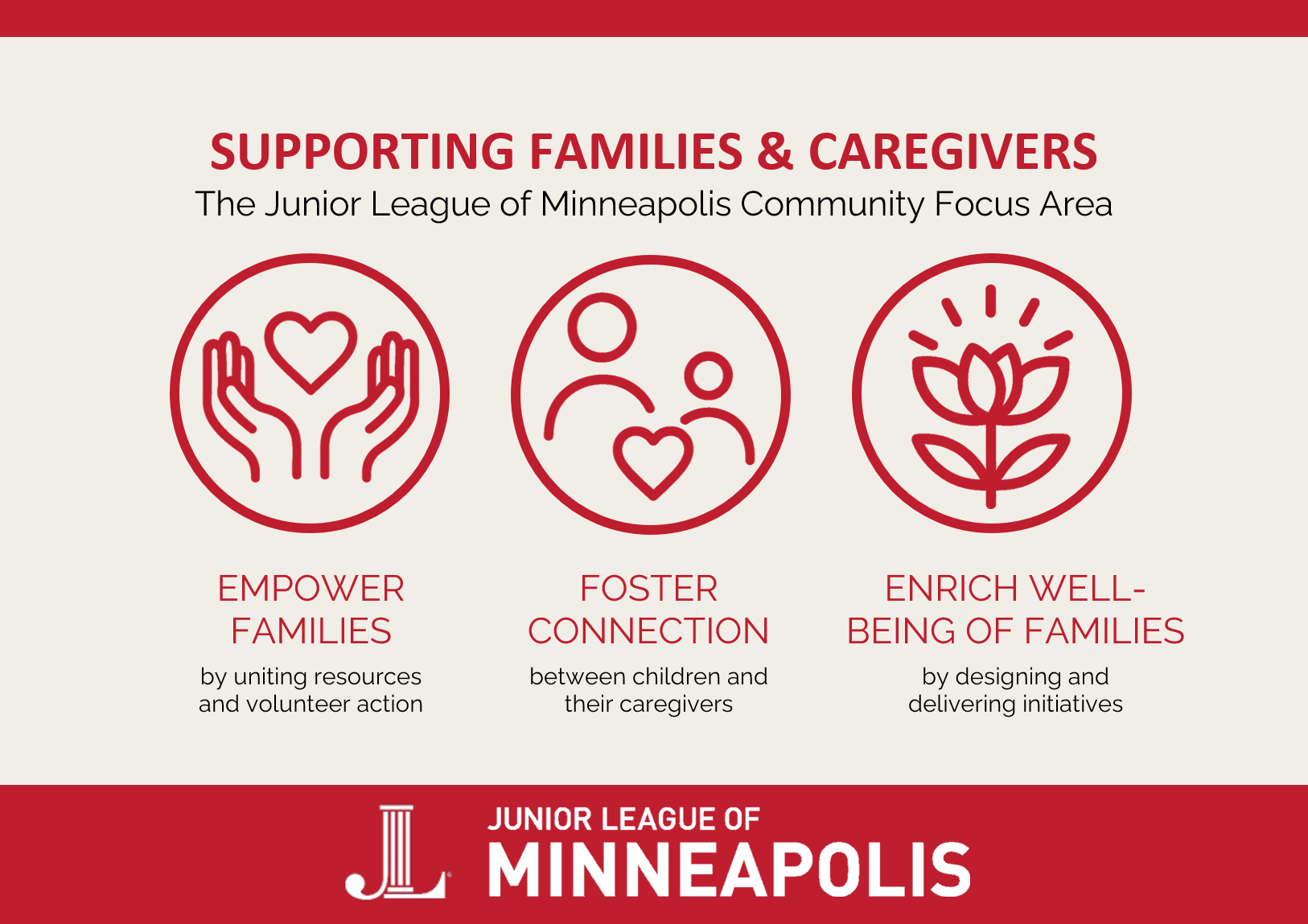
The work done to support caregivers and families can lead to better outcomes for children and stronger communities. By fostering connections between children and their caregivers, uniting families with resources, and focusing on projects that enrich the lives of families, JLM aims to make a long-lasting, meaningful impact on the community.
Over the course of 100 years, The Junior League of Minneapolis has established a legacy built by bridging critical resource gaps and mobilizing trained volunteers to create a stronger, healthier community. Today, many families face economic and housing instability, barriers to accessing essential services, and mental health challenges. JLM amplifies the impact of our local partner organizations in meeting pressing needs and maintains agility with our trained volunteers to change course with the changing needs of our community.
Strategy 1: Empower Families by Uniting Resources and Volunteer Action
Connecting families with essential resources is a game-changer. When families can access one resource within their community, it improves their well-being and increases the likelihood they will engage with additional resources and become more active within the community (Cheng et al., 2022). JLM amplifies these connections by supporting our community partners with volunteers and resources. From short-term “Done-in-a-Day” activities that provide immediate impact to longer-term collaborations that nurture growth, our efforts scale the impact of existing community programs to ensure enduring positive outcomes for all.
Strategy 2: Foster Connection Between Children and Their Caregivers
A consistent and secure connection between a caregiver and a child plays a critical role in development, contributing to higher self-esteem and decreased rates of anxiety and depression in adulthood (Smith et al., 2023). This connection also profoundly impacts caregivers’ mental health, acting as a buffer against stress (Huston & Bentley, 2016). JLM nurtures these relationships through initiatives like Between the Lines, which connects children with their incarcerated caregivers through reading. Past initiatives such as H.O.M.E.S. and partnerships with local organizations, such as Bridging, have also been vital in strengthening caregiver-child relationships in the community.
Strategy 3: Design and Deliver Initiatives that Enrich the Well-Being of Families
Since its inception in 1923, The Junior League of Minneapolis has significantly and positively impacted Minneapolis families, initiating and supporting more than 130 historical projects. In 2023, our Clothesline Pop-Up celebrated our organization’s centennial, directly benefited our community partners — the Greater Minneapolis Crisis Nursery and Free Arts, a Big Brothers Big Sisters Twin Cities program — and won the 2023 Fund Development Award from AJLI. Today, our talented membership maintains the ability and expertise to innovate and deliver new initiatives as needed.
Join Us In This Work!
Our intended strategies require member involvement, meaningful collaboration with community organizations, and community engagement. We welcome you to learn how to join us, support our work, and get involved.
References
- Administration for Children and Families. (2017). Parent work schedules in households with young children: Implications for child care subsidies. U.S. Department of Health & Human Services. https://acf.gov/sites/default/files/documents/opre/parent_work_schedules_in_households_with_young_children_toopre_083117.pdf
- Cheng, E. R., Palakshappa, D., Kleinman, K. P., & Fiechtner, L. G. (2022). Food insecurity, caregiver stress, and obesity among children. Journal of Pediatrics, 245, 124–131. https://pmc.ncbi.nlm.nih.gov/articles/PMC9140710/
- Huston, A. C., & Bentley, A. (2016). Too many hours in child care? The effects of quantity of care on child development. Early Childhood Research Quarterly, 36, 152–166. https://pmc.ncbi.nlm.nih.gov/articles/PMC5004250/
- Minnesota Compass. (n.d.). Minnesota households: Trends and characteristics. Wilder Research. https://www.mncompass.org/profiles/state/minnesota/households
- Smith, J., Brown, R., & Lee, M. (2023). Parental employment, childcare access, and child well-being: A longitudinal study. Journal of Family Studies. https://pubmed.ncbi.nlm.nih.gov/37842789/
- University of Minnesota Humphrey School of Public Affairs. (2023). Who cares? The impact of caregiving responsibilities on economic well-being. https://www.hhh.umn.edu/sites/hhh.umn.edu/files/2023-03/WhoCares-v5.pdf
- Wilder Research. (n.d.). Children’s Minnesota community health needs assessment: Detailed findings. https://www.wilder.org/wilder-research/research-library/childrens-minnesota-community-health-needs-assessment-detailed